The functional departments, BUs and factories are responsible for the specific promotion and implementation of sustainable development work

In 2025, Kaifa has reached the historic milestone of its 40th anniversary. After four decades of hard work, we have continuously pioneered and explored, growing into a trusted partner in the global supply chain. Over the past four decades, our values have been passed from generation to generation, with our original aspiration of "Contributing to national development through industry" and our vision of "To be a Reliable and Respectable Enterprise" , guiding us towards a new stage where responsibility empowers our future. In this pivotal year that bridges the past and the future, we not only reflect on our magnificent journey, but also open a new chapter for the future with a solid commitment to sustainable development.
2025 is a crucial and fruitful year for Kaifa to deeply cultivate and empower the high-quality sustainable development. At the governance level, we continue to improve the four-level governance structure of “coordinated by the Board of Directors, supported by the Strategy and Sustainable Development Committee, implemented by the Sustainable Development Working Group and coordinated across Departments”. We incorporate sustainability goals into the organizational performance evaluation system to ensure the institutionalization and implementation of the sustainability strategy. The company's ESG ratings have scaled new heights: it has firmly maintained its position in the top 10% of the industry in mainstream domestic ESG ratings, and achieved breakthrough growth in core indicators of the world's top-tier ESG rating systems.
Green and low-carbon practices are the core of sustainable development for enterprises. We actively support the "dual carbon" goal by establishing a comprehensive green manufacturing system that encompasses green products, green factories, green industrial parks, and green supply chains. Through a series of measures, including rooftop distributed photovoltaic power generation, waste heat recovery from air compressors, and process optimization to reduce energy consumption, the proportion of renewable energy usage continues to rise, while energy intensity steadily declines. With the low consumption and high efficiency, our independently developed green products, such as smart meters and IoT water meters, help customers achieve a low-carbon transition. By refining our green supply chain management system that spans the entire product lifecycle, we are progressively implementing end-to-end control from raw material procurement to product recycling, and are working with upstream and downstream partners to build a green ecosystem.
Our ESG progress relies on the trust and support of all our stakeholders. We have always cherished the collaborative and symbiotic relationship with our investors, customers, suppliers, employees, and communities. We listen to their needs through regularized communication mechanisms, respond to their concerns via transparent information disclosure, and forge strong synergy for sustainable development through win-win collaboration
Innovation is the primary driving force for development, putting people first is the cornerstone of a company's enduring growth. In 2025, Kaifa filed a cumulative total of 1,805 applications for patents and software copyrights, with 983 cumulative patents granted. We drove improvements in production efficiency through digital and intelligent technological upgrading. We adhere to the "young, international, knowledge-driven" talent strategy: the average training hours per employee exceeded 30 throughout the year. We built a fair and diversified career development platform, the proportion of female employees remained above 30%, and the employee satisfaction score reached 4.06 points. All these efforts enable every employee to realize their self-worth alongside the company's development. At the same time, we actively participate in rural revitalization and public welfare initiatives, drive employment through industrial development, give back to society with a strong sense of responsibility, and demonstrate our corporate commitment.
Looking ahead, Kaifa will continue to follow the guidance of sustainability goals, and deepen the implementation of its sustainability strategy centered on "Upholding Integrity and Innovation, Putting People First, Embracing Green and Low-Carbon". We will continue to advance efforts in addressing climate change, driving industrial upgrading, safeguarding employee rights, and fulfilling social responsibilities. We will make steady progress toward the long-term goals: achievie a 50% reduction in Scope 1 and Scope 2 greenhouse gas emissions by 2035, achieve 60% renewable energy usage by 2050, and achieve carbon neutrality by 2060.
Despite the challenges ahead, with unwavering perseverance, we will steadily move forward and ultimately embrace a hopeful future. Kaifa is committed to working with all stakeholders to build consensus and deepen cooperation through the common goal of sustainable development, and together we will write a new chapter of sustainable development characterized by economic growth, environmental friendliness, and social harmony!
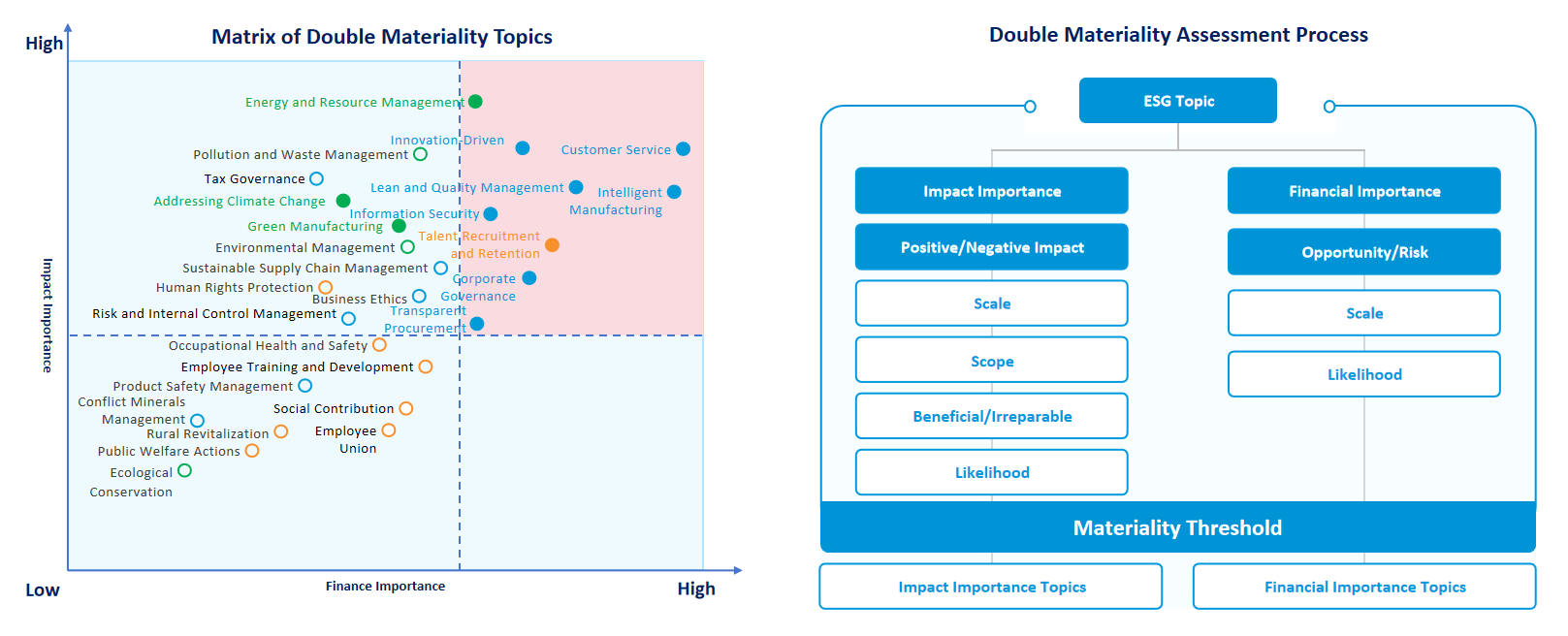
Material topics are the core of ESG management and disclosure. To accurately grasp the company's sustainability context and precisely identify stakeholder demands and expectations, Kaifa has established a systematic mechanism for identifying, evaluating, and confirming material topics. Annually, through questionnaires, interviews, and other methods, we continuously assess and prioritize Kaifa's environmental, social, and governance materiality based on double dimensions of “financial importance” and “impact importance.” This process is regularly reviewed and updated annually by the Sustainable Development Working Group. This ensures consistent focus on critical topics, providing clear guidance for formulating sustainability strategies and implementing actions. In the future, Kaifa will continue to closely monitor evolving stakeholder expectations, periodically conducting dynamic reviews and optimizations of material topics, which enable more comprehensive and precise guidance for the company's ESG practices and continuous improvement.